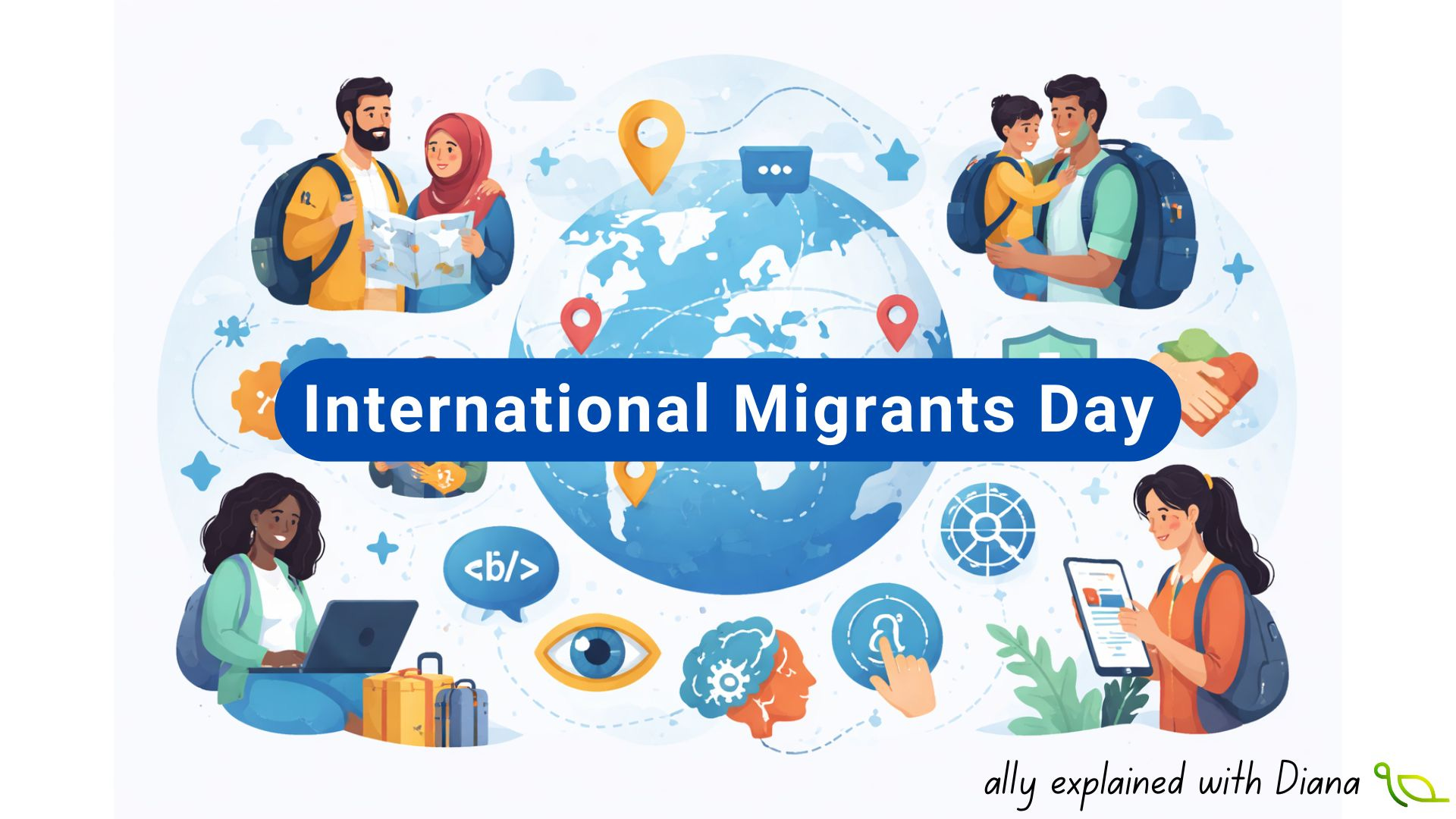
Web accessibility beyond disability: International Migrants Day

When people hear web accessibility, most think about disabled users, some also think about older adults or people with cognitive impairments. Experts know it’s for everyone, but one group is still rarely mentioned: migrants. And today is International Migrants Day.
I know this firsthand: I moved first to Denmark, then to France and like many migrants, I depended heavily on websites for first-need services: healthcare, administration, housing, education, work.
Not because I couldn’t see or hear, but because of the following reasons:
The language was overly complex, full of idioms and legal phrasing
Forms were broken, unclear, or unforgiving to small mistakes
Instructions assumed cultural knowledge I simply didn’t have
Navigation followed local mental models that weren’t obvious to a non-native user
For a migrant, clarity is accessibility.
Plain language is accessibility.
Consistent design is accessibility.
Error-tolerant forms are accessibility.
Research shows that language and information barriers are among the biggest obstacles migrants face:
One qualitative study of Nepali migrants in Finland found that limited language proficiency made it difficult to understand healthcare processes and navigate information, pushing people to rely on informal networks for inconsistent guidance.
Another systematic review highlights that language and cultural barriers significantly limit equitable access to services, including healthcare, and that meaningful translation and mediation help reduce those gaps.
A study of migrants in Portugal found that while access to digital devices is high, trust and usability of online resources vary widely depending on language, education, and cultural background.
This matters for web accessibility because accessibility is fundamentally about reducing barriers, whether those barriers are physical, cognitive, linguistic, or cultural.
So today, on International Migrants Day, let’s broaden the conversation:
🔹 Accessibility isn’t only about disability
🔹 It’s about equitable access to information and services
🔹 It’s about real people who are rebuilding their lives and deserve clear, inclusive digital design
When we make the web easier to understand and navigate, we make the world a little less isolating.