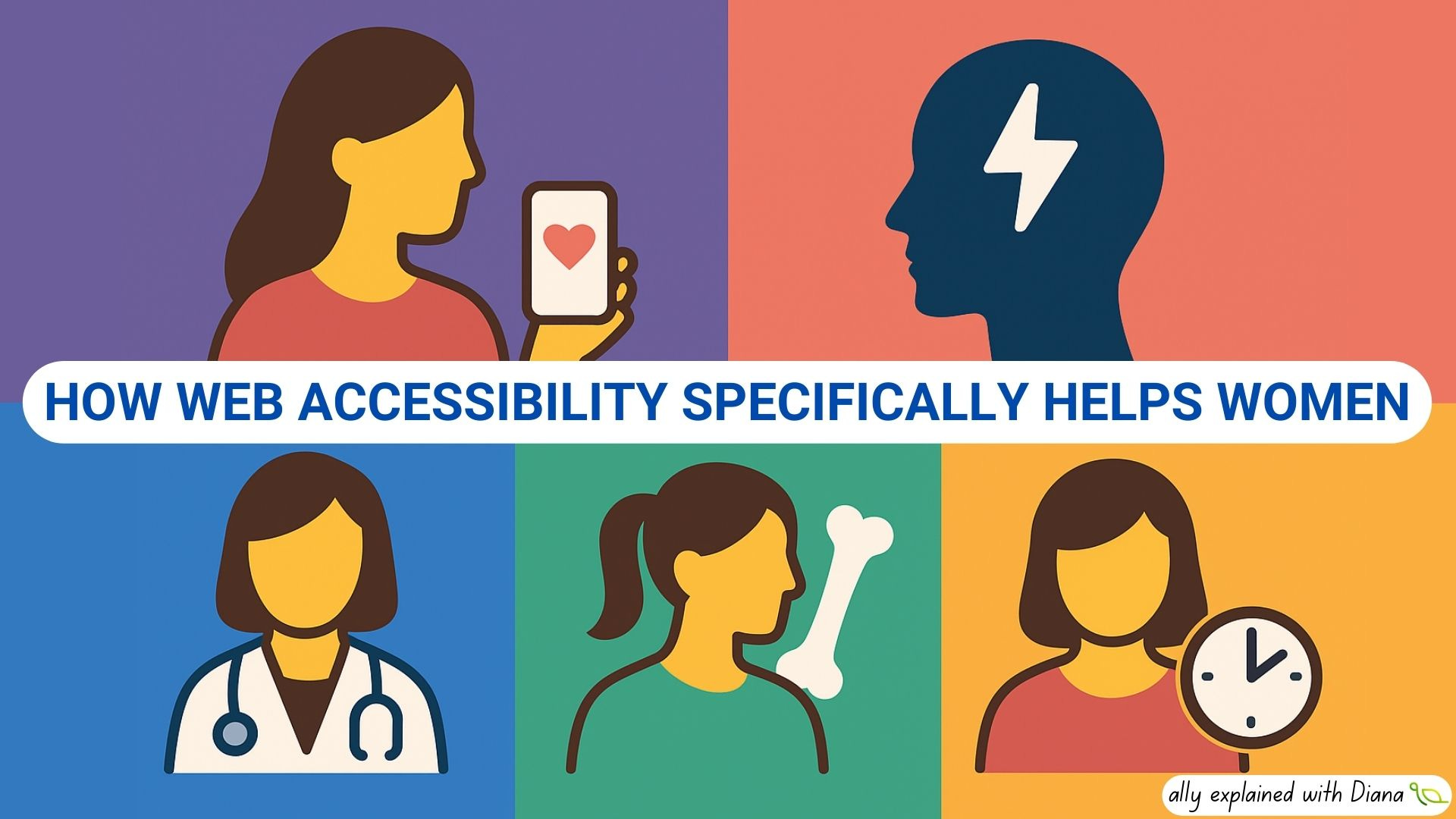
How web accessibility specifically helps women

Web accessibility is often framed around disability, but in reality it quietly supports millions of women every day, often without them ever using the word “accessibility”.
Endometriosis & digital health tools
Why it matters: endometriosis affects around 10 % of women of reproductive age worldwide and is associated with chronic pain, fatigue, depression, and delayed diagnosis (often 7–10 years).
Web problem: women increasingly rely on e-health apps to track pain, symptoms, cycles, and treatments, yet many tools lack proper semantics, keyboard support, clear forms, or readable data visualisation, making consistent tracking difficult.
How accessibility helps: accessible e-health interfaces allow symptom logging during pain flares or brain fog through structured content, predictable interactions, and keyboard-usable forms, supporting continuity of care and self-advocacy.
WCAG 1.3.1, 2.1.1, 2.4.6, 3.3.2, 1.4.4
Migraines
Why it matters: up to 33 % of women experience migraines at some point in life, significantly more than men.
Web problem: rapid motion, auto-play media, and low contrast are common migraine and sensory triggers.
How accessibility helps: reduced motion options, pause/stop controls, and sufficient contrast improve comfort and usability.
Cognitive load & health anxiety
Why it matters: women with chronic conditions often experience higher anxiety and cognitive burden, making clear health information essential.
Web problem: complex language, dense content, and inconsistent navigation overwhelm users seeking symptoms or treatment information.
How accessibility helps: clear labels, simple structure, predictable navigation, and easy-read content reduce stress and improve comprehension.
Osteoporosis & intersectional conditions
Why it matters: osteoporosis disproportionately affects women, especially with age, and is linked to higher risk of migraines, compounding barriers.
Web problem: health sites often fail to support multi-condition research through clear structure, navigation, and search.
How accessibility helps: semantic structure and navigable content help users find and connect relevant information more efficiently.
Young mothers, caregiving & situational disability
Why it matters: women perform over 75 % of unpaid care work globally, and new mothers often use devices one-handed, without sound, and under frequent interruption.
Web problem: many digital products assume full attention, two hands, sound on, and uninterrupted time.
How accessibility helps: accessible design supports silent use, larger targets, keyboard alternatives, and pause-and-resume interactions, making digital tools usable in real life.
WCAG 1.2.2, 2.5.5, 2.2.1, 2.1.1
Thank you so much for this information. I will be preparing content for workshop soon. I expect it will be mostly women in attendance. So this info will definitely resonate with them and may help them to better understand the need for A11Y.