Case study: IKEA
How IKEA became a leader in digital accessibility and what others can learn

When we think about IKEA, we think design and innovation. But their digital accessibility journey is just as inspiring and it shows what many global retailers still miss.

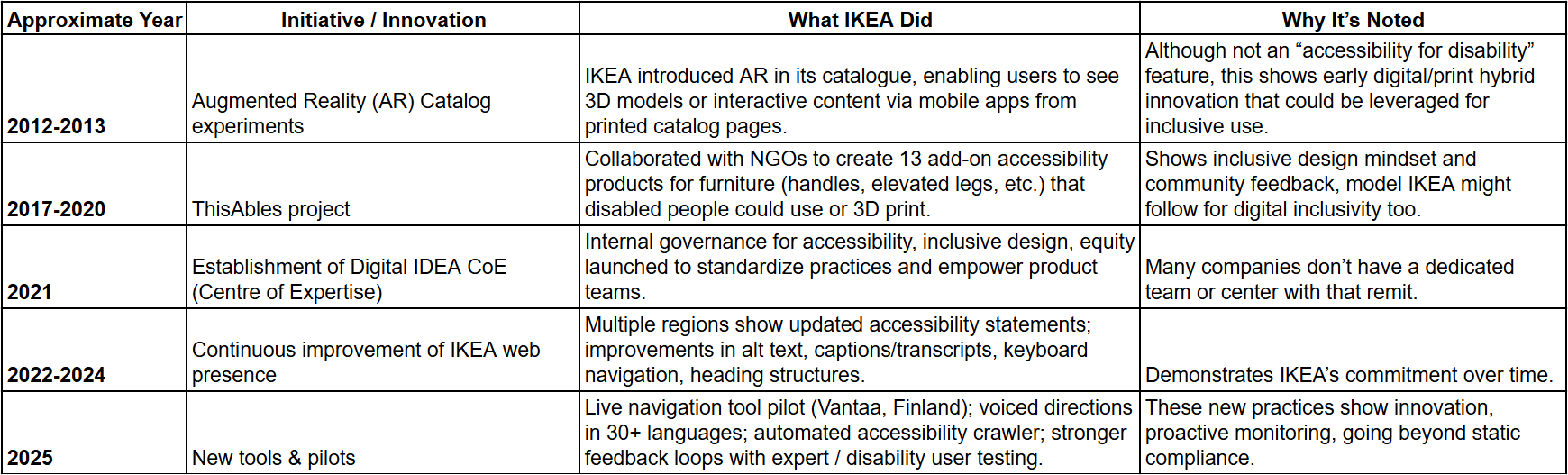
Quick chronology
2012–2013: IKEA experiments with digital innovation in its catalogues, adding AR features. Not directly accessibility-focused, but an early sign of blending digital + inclusive design.
2017–2020: Launch of the ThisAbles project — furniture add-ons designed with NGOs to make IKEA products more usable for people with disabilities. A strong signal of inclusive innovation.
2021: They created a Digital Inclusive Design, Equity & Accessibility Centre of Expertise — giving accessibility a seat at the table.
2022-2024: Regular updates, user testing with people with disabilities, and transparent “partially conformant” notices on websites.
2025: Launching new tools: a live navigation pilot in Vantaa (Finland) with voiced directions in 30+ languages, automated crawlers to monitor accessibility, continuous testing with users with disabilities, clear transparency about what still needs work.
What sets Ikea apart from other companies?
Transparency about partial conformance (instead of pretending it’s “done”)
A dedicated accessibility & inclusion governance body
Experimentation with multilingual voice navigation and automated monitoring
Collaboration with disabled communities, both in physical products and in digital services
Gaps still to address
Partial compliance in many regions
IKEA Sweden’s digital statement says their website and app are partially conformant with WCAG 2.2 Level AA. Some content still doesn’t meet criteria (alt text, decorative images, videos, heading structure).
Declarations of non-conformance under RGAA in France
IKEA France states their site is non-conformant with RGAA version 4.1.2 due to non-conformities and derogations.
Usability issues remain for assistive tech & special situations
From Finland: their app and website are partially compliant with WCAG 2.1 AA. They report issues like form errors not clearly identified, input fields lacking labels or instructions, missing ARIA properties, poor announcements of dynamic updates, color contrast issues.
Accessibility of IKEA Apps less complete than websites
Many regional statements explicitly state the app has more non-accessible content than the website: missing alt text, inaccessible headings, missing video captions, and screen reader compatibility problems. Sweden’s statement is one example.
Inconsistent implementation of responsive/adaptive features
From Austria statement: some interface components lack semantic structure; some dynamic updates aren’t announced; certain gestures or media cannot be controlled or paused.
Lack of publicly published roadmap / plan for future compliance
Ikea France mentions “plans 2025-2027” being drafted, but doesn’t publish full schedule yet.progress or hold accountable.
For companies in Sweden and across Europe, IKEA shows that accessibility isn’t just compliance (WCAG or RGAA), it’s strategy, trust, and innovation. Yet, even leaders have gaps. And this is where accessibility specialists and consultants play a crucial role: keeping companies accountable, harmonizing standards, and pushing for the next level.