5 free accessibility apps making impact in 2026

I follow apps that help people live more independently, especially those that use technology to remove barriers and make everyday life more accessible.
Here are 5 free accessibility apps that inspired me:
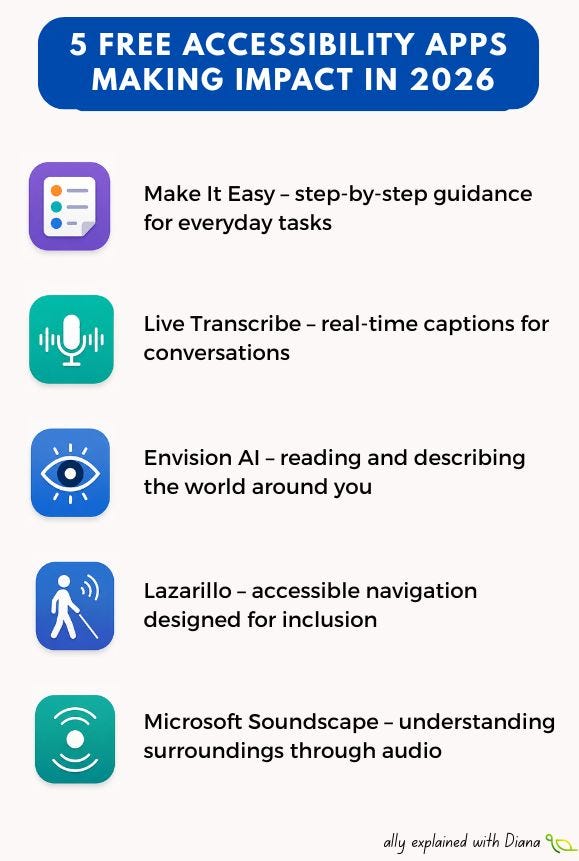
1️⃣ Make It Easy – step-by-step guidance for everyday tasks
Make It Easy helps people complete everyday activities through simple, visual, and personalized instructions. Tasks can be broken down into manageable steps, supporting independence and confidence in daily life.
👉 Who it helps: people with cognitive disabilities, autism, acquired brain injuries, dementia, and others who benefit from structured guidance.
👉 Why it’s useful: transforms complex tasks into clear, achievable steps that support autonomy rather than dependence.
2️⃣ Live Transcribe – real-time captions for conversations
Live Transcribe provides instant speech-to-text captions for face-to-face conversations, meetings, and public interactions. It supports more inclusive communication without requiring specialized equipment.
👉 Who it helps: deaf and hard-of-hearing individuals, as well as people communicating in noisy environments.
👉 Why it’s useful: makes spoken conversations accessible in real time, helping people participate more fully at work, school, and in everyday life.
3️⃣ Envision AI – reading and describing the world around you
Envision AI uses a smartphone camera to read text, recognize objects, describe scenes, and identify products. This app provides immediate access to visual information when needed.
👉 Who it helps: blind and low-vision users seeking greater independence in everyday activities.
👉 Why it’s useful: turns visual information into accessible audio feedback, supporting navigation, shopping, and information access.
4️⃣ Lazarillo – accessible navigation designed for inclusion
Lazarillo is a GPS navigation app created specifically for blind and visually impaired users. It provides audio guidance and information about nearby places, helping users navigate independently.
👉 Who it helps: people with visual impairments who need accessible navigation support.
👉 Why it’s useful: makes exploring new environments more confident and accessible through audio-first guidance.
5️⃣ Microsoft Soundscape – understanding surroundings through audio
Soundscape uses spatial audio to provide awareness of nearby streets, landmarks, and points of interest. Rather than replacing traditional navigation, it helps users build a richer mental map of their environment.
👉 Who it helps: blind and low-vision individuals navigating unfamiliar areas.
👉 Why it’s useful: enhances environmental awareness and orientation, supporting more independent mobility.
Which accessibility app have you used or would add to this list?
Microsoft Soundscape was discontinued a long time ago and other apps were allowed to use the basic API for their apps, like Voice Vista and SoundScape Community. Also, Be My Eyes, especially their AI channel is much better than Envision AI.