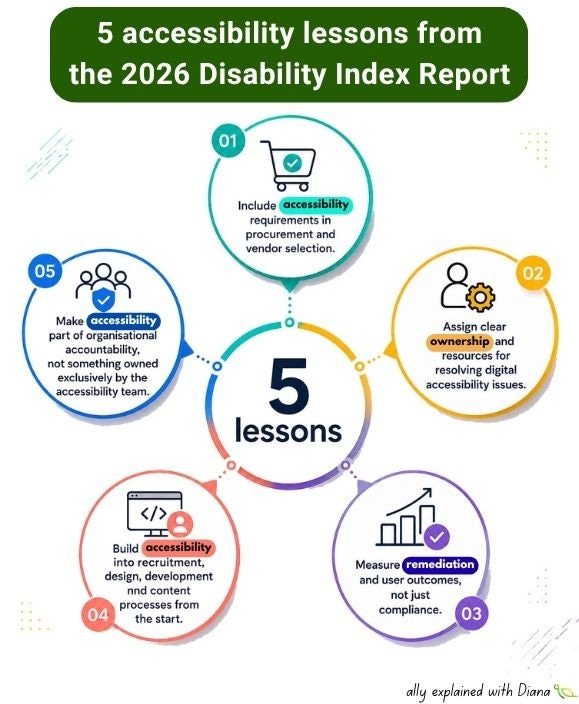
5 accessibility lessons from the 2026 Disability Index Report

The 2026 Disability Index Report reveals an interesting paradox: companies are making strong progress in supporting employees with disabilities, but accessibility becomes much less mature when we look at governance, procurement and customer-facing digital experiences.
Here are some encouraging numbers (the percentages represent the share of participating companies that have each practice in place):
95% report universally designed digital assistive supports, such as captions, transcription and audio descriptions.
98% provide flexible or remote work accommodations.
95% report universally designed physical supports.
But the picture changes when we look at accountability:
Only 48% require suppliers to meet physical and digital accessibility requirements.
Only 47% have a formal process to remediate accessibility issues originating from suppliers.
Only 31% include workforce disability representation in annual reports.
And EMEA (Europe, the Middle East and Africa) shows an especially interesting gap: while the region performs relatively well in disability-related reporting, only 50% of companies report having resources dedicated to resolving accessibility and compatibility issues for customers using public-facing digital products and content, compared with 74% globally. Only 56% provide instructions for requesting accommodations through public-facing recruitment websites, compared with 77% globally.
I think it highlights an important accessibility maturity issue: having accessible tools is not the same as having accessibility embedded into an organisation. If accessibility is considered only after a product is purchased, a website is launched or a customer reports a barrier - we’re already too late.
Organisations can take some practical steps:
Include accessibility requirements in procurement and vendor selection.
Assign clear ownership and resources for resolving digital accessibility issues.
Measure remediation and user outcomes, not just compliance.
Build accessibility into recruitment, design, development and content processes from the start.
Make accessibility part of organisational accountability, not something owned exclusively by the accessibility team.
The next step in accessibility maturity is building organisations that are structurally capable of creating and maintaining accessible digital experiences.